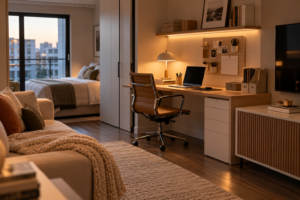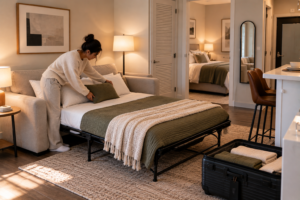
You may have chosen the right furniture, added a beautiful rug, and carefully arranged every detail in your living room. Yet when evening comes and you turn on the main overhead light, the apartment still feels cold and uninviting.
Often, the problem isn’t the decor. It’s the lighting.
In a rental apartment, changing electrical fixtures, adding new light sources, or replacing hardwired fixtures may require permission. Fortunately, you don’t need to make any of those changes to transform the atmosphere.
Floor lamps, table lamps, and other plug-in options allow you to create multiple layers of light without permanently modifying the apartment. And when it’s time to move, they can come with you.
The key is to stop thinking only about “making the room brighter” and start choosing lighting based on what actually happens in each space.
Don’t Depend on a Single Overhead Light
One strong light in the center of a room may illuminate everything, but it rarely creates a cozy atmosphere.
Instead, distribute smaller light sources at different heights.
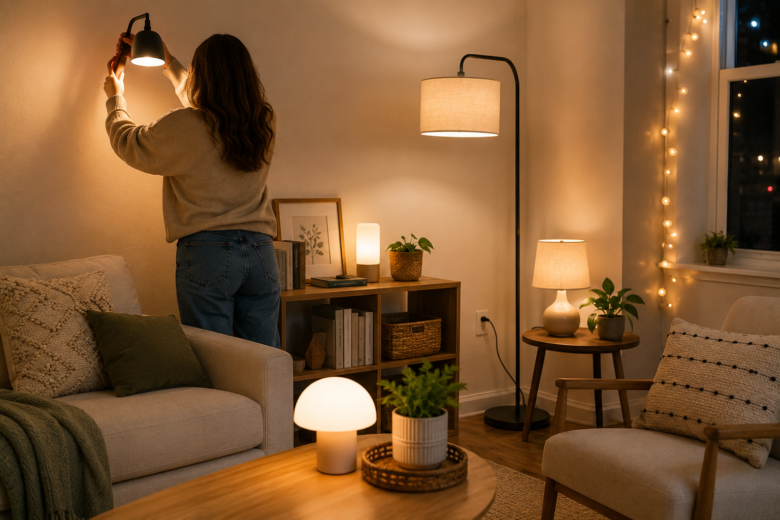
A living room, for example, could combine the existing overhead light with:
- a floor lamp beside the sofa;
- a table lamp in a corner;
- a small reading light.
You don’t need to use them all at the same time.
The advantage is being able to adjust the lighting to the moment. Entertaining guests requires a different atmosphere from watching TV before bed.
Start by Identifying Dark Corners
Wait until nighttime before deciding which lamps to buy. Turn on only the lights already available in the apartment and look around.
Where do you notice excessive shadows?
Is there a corner of the living room that almost disappears?
Is the area around your favorite chair too dark?
Does your workspace have enough light?
Make a short list of the areas that actually need additional lighting.
This prevents you from buying lamps simply because they look beautiful and later realizing they don’t solve a real problem.
Choose the Lamp Based on Its Purpose
Different types of lamps work better for different situations.
Floor lamps are useful for creating indirect lighting in living rooms and bedrooms without taking up table space.
Table lamps work well on nightstands, consoles, and side tables.
Task lamps are better when you need focused light for reading, studying, or working.
Before choosing a design, ask yourself:
“What do I want to be able to do with this light?”
The answer will help determine the appropriate height, brightness, and placement.
Pay Attention to Color Temperature
Not every white light creates the same feeling.
Color temperature is usually listed on the light bulb packaging in Kelvin, represented by the letter K.
Lower values create a warmer, more yellow-toned appearance. Higher values produce a whiter or more blue-toned light.
For spaces designed for relaxation, such as living rooms and bedrooms, many people prefer warmer lighting, often around 2700K to 3000K.
For task-oriented areas, a more neutral light may work better.
The important thing is to check this information before buying bulbs so you don’t accidentally end up with completely different color temperatures in the same room.
Consider Brightness Not Just Wattage
When choosing a bulb, also look at the lumens, which indicate how much light it produces.
A decorative lamp on a side table doesn’t necessarily need to produce the same amount of light as a lamp used for reading.
Think about the purpose.
Are you trying to create a soft glow in the corner of the living room or illuminate a work surface?
Choosing the right brightness helps prevent two common problems: a room that’s still too dark or a lamp so bright that it eliminates the cozy atmosphere you were trying to create.
Use Indirect Light to Soften the Room
Not every lamp needs to point directly toward you.
Light directed toward a wall or ceiling can spread more softly throughout the room.
A strategically positioned floor lamp can brighten a dark corner without shining harsh light directly into your eyes.
Lampshades can also help diffuse the light.
Experiment with different positions before deciding where a lamp will permanently stay. Sometimes moving it just a few inches can noticeably change the effect.
Take Advantage of Options That Don’t Require Permanent Installation
For renters, flexibility is valuable.
Prioritize lighting that can be installed and removed without structural changes.
In addition to traditional plug-in lamps, some rechargeable or battery-powered lights can work in areas where a convenient outlet isn’t available.
If you’re considering adhesive-mounted lighting, check:
- the supported weight;
- recommended surface types;
- removal instructions;
- your rental property’s rules.
“Removable” doesn’t automatically mean “safe for every wall.”
Check Outlet Locations Before Buying
The perfect lamp becomes much less useful when there isn’t an outlet nearby.
Before purchasing one, decide approximately where it will go and locate the available outlets.
Also think about where the cord will run.
Avoid placing cords across walkways or anywhere they could become a tripping hazard.
If an extension cord is necessary, make sure it’s appropriate for the equipment and follow the manufacturer’s safety recommendations.
Use Smart Bulbs When They Make Sense
A smart bulb can add flexibility without requiring changes to the electrical system.
Depending on the model, you may be able to adjust brightness, create schedules, and control the light from your phone.
This can be especially useful when the same lamp needs to serve different purposes throughout the day.
But don’t make technology a requirement.
If a regular lamp with a well-chosen bulb solves your problem, it’s already doing exactly what you need.
Use This Checklist Before Buying
Before choosing your lighting, make sure you’ve:
- observed the apartment at night;
- identified the areas that are actually too dark;
- defined the purpose of each lamp;
- checked the color temperature;
- compared lumen levels;
- located nearby outlets;
- planned where cords will run;
- avoided permanent modifications;
- checked rental rules before using adhesive solutions.
You Don’t Need to Renovate to Completely Change How Your Apartment Feels
Good lighting doesn’t just draw attention to a lamp. It changes the way everything else in the room is perceived.
The sofa feels more inviting. The bedroom becomes calmer. A forgotten corner suddenly feels like part of the space.
And that transformation doesn’t require an electrician, new wiring, or permanent changes.
Start by looking at your apartment at night. Notice where the existing lighting falls short and add new light sources with intention.
When every lamp has a purpose, you buy less, use your space more effectively, and create an atmosphere that can move with you to your next home.
Because in a rental apartment, you may not be able to change everything. But you can completely change the way the space makes you feel.