
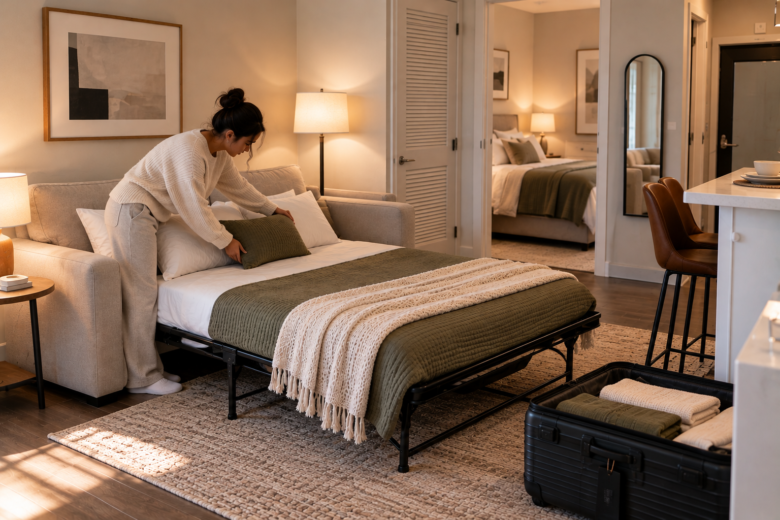
Hosting friends or family in a one-bedroom apartment can feel challenging when there is no separate guest room. The living room already needs to support your everyday routine, storage is usually limited, and adding one more piece of furniture can easily interfere with the flow of the space.
Still, you do not need to permanently turn your apartment into a bedroom to make guests feel comfortable. The key is to create a temporary setup that is easy to assemble and just as easy to put away. Your home can remain functional most of the time while still being ready when someone comes to stay.
With furniture that fits the room and a little advance planning, you can provide privacy, organization, and a comfortable place to sleep without making the entire apartment feel smaller.
Decide Where Your Guest Will Sleep
Before buying any furniture, study your apartment’s layout and choose the most practical area. In most one-bedroom apartments, the living room is the natural choice, but not every corner will work equally well.
Look for a location that provides:
- Easy access to the bathroom;
- Some distance from the kitchen;
- Limited exposure to light at night;
- Enough room to fully open the bed;
- A clear path to the front door;
- Convenient access to an electrical outlet.
Use a tape measure to check the available space with the furniture both closed and fully extended. Remember to account for luggage, shoes, and personal belongings. A sleeper sofa may technically fit in the living room but still block the entire walkway once it is opened.
Choose a Bed That Does Not Take Over the Room
A sleeper sofa is a popular solution, but it is not the only option. The best choice depends on the size of your apartment and how often you host overnight visitors.
Sleeper Sofa
This option works well if you regularly host guests and already need a sofa. Before buying one, test the opening mechanism and confirm its fully extended dimensions. Models with oversized arms and bulky frames may consume valuable floor space without adding meaningful comfort.
Futon or Sleeper Chair
A compact futon can be practical for occasional visitors. A sleeper chair is even more space-efficient when you usually host only one person.
Air Mattress
An air mattress is affordable, easy to store, and useful for infrequent visits. Choose a model with a built-in pump and enough height to make getting in and out of bed comfortable. Store it in a protected area to reduce the risk of punctures and moisture damage.
Folding Mattress
Sectional folding mattresses can be stored in a closet or used as floor seating during the day. They are a practical alternative when there is not enough room for a traditional sleeper sofa.
The best option is not necessarily the most expensive one. It is the one that does not make your apartment less functional during the rest of the year.
Keep Walkways Clear
A guest space is only functional if no one has to climb over luggage or squeeze around furniture to reach the bathroom.
Identify the apartment’s main traffic paths, including the routes to the entrance, kitchen, bathroom, and bedroom. These walkways should remain accessible even when the guest bed is fully open.
Avoid placing the sleeping area in front of doors, closets, heating vents, or air-conditioning registers. Do not block windows that may be needed for ventilation or serve as an emergency exit.
If you need to move the coffee table whenever a guest stays over, choose a lightweight model, one with casters, or a set of small nesting tables. Furniture that is easy to reposition allows you to prepare the room without turning every visit into a full-scale move.
Create Privacy Without Building Walls
Even when your guest sleeps in the living room, you can still provide a reasonable sense of privacy. Use temporary features that do not permanently consume floor space.
A folding room divider can be opened at night and stored away in the morning. Curtains installed on an appropriate ceiling track can also separate the area, provided your lease allows the installation.
An open shelving unit is another option. It can visually divide the room without completely blocking the light while also providing storage. However, it must be stable and should not make the walkway too narrow.
If a divider is not practical, small considerations still help. Provide a sleep mask, explain the household schedule, and avoid walking through the living room while your guest is resting whenever possible.
Provide Temporary Storage
Living out of an open suitcase on the floor will make any apartment feel more crowded. Prepare a place where your guest can keep personal belongings organized.
You might clear one or two drawers, reserve a few closet hangers, or provide a basket. A storage bench can hold extra bedding while also serving as a luggage rack.
Removable hooks can be useful for coats, bags, and towels, but make sure they will not damage the paint. A small tray on a side table gives your guest a dedicated place for a phone, glasses, keys, and charger.
You do not need to create a complete closet. The goal is simply to prevent your guest’s belongings from spreading throughout the living room.
Prepare a Dedicated Guest Kit
Keeping guest supplies together makes the space easier to set up and prevents last-minute shopping trips.
Your kit may include:
- Clean sheets;
- Pillows;
- A seasonally appropriate blanket;
- Towels;
- A mattress protector;
- A sleep mask;
- A universal charging cable;
- A small night-light;
- Basic toiletries.
Store everything in a labeled container, an empty suitcase, or a multifunctional piece of furniture. This keeps items that are used only occasionally from occupying your everyday living space.
Step by Step: Set Up the Guest Space
1. Remove Only What Is Necessary
Move fragile objects and anything currently occupying the area where the bed will go.
2. Open the Sleeping Surface
Make sure it is stable and does not block the apartment’s main walkways.
3. Arrange the Bedding
Use clean sheets, comfortable pillows, and bedding appropriate for the temperature.
4. Create a Bedside Area
Place a small table or tray near an accessible electrical outlet.
5. Make Room for Personal Belongings
Provide hangers, a basket, a drawer, or a luggage rack.
6. Adjust the Lighting and Privacy
Close the curtains, position the temporary divider, and provide an easy-to-reach light.
7. Explain the Household Routine
Show your guest where to find towels, drinking glasses, bathroom supplies, and temperature controls.
A Small Home Can Still Be Incredibly Welcoming
Hosting someone comfortably does not depend on having an empty bedroom. It depends on anticipating their needs, keeping walkways open, and preventing temporary solutions from becoming permanent obstacles.
When every item has a purpose and a designated storage place, the living room can become a comfortable sleeping area at night and return to its regular function the next morning.
Your guest probably will not remember the size of your apartment. They will remember the clean sheets, the designated place for their suitcase, and the feeling that you genuinely prepared the space to welcome them.
Comments
I really liked the point about keeping the walkways clear even when the guest bed is open. That’s one of those things that sounds obvious, but in a small apartment it can make a huge difference. Nothing makes a space feel more cramped than having to squeeze around furniture every time you walk through the room. Thks.