Setting up a kitchen in a new apartment can easily turn into a series of purchases that all seem essential at the time.
Huge cookware sets, dozens of utensils, single-purpose appliances, containers in every possible size, and gadgets designed to simplify tasks you may rarely even do.
Once everything arrives, the real problem appears: crowded cabinets and a kitchen filled with items that barely get used.
A complete kitchen doesn’t need to have everything. It needs what allows you to prepare, cook, serve, store, and clean the food that’s actually part of your routine.
If you’re starting from scratch, you have a major advantage: you can build your kitchen intentionally from the very first purchase, buying less and choosing better.
Start With Your Routine Instead of a Generic Checklist
Before buying anything, think about how you actually eat during a typical week.
Do you make breakfast at home?
Do you cook full meals?
Do you pack food for work or school?
Do you regularly have guests over?
Do you use the oven, stovetop, or microwave most often?
These answers matter more than any list of “50 kitchen essentials.”
Someone who cooks every day needs a different setup from someone who prepares simple meals a few times a week.
Your goal isn’t to build the kitchen a checklist says you should have. It’s to create one that works for you.
Divide Your Purchases Into Five Functions
One simple way to avoid buying too much is to organize everything by function.
Your kitchen needs to allow you to:
- prepare food;
- cook;
- serve;
- store;
- clean.
Before buying an item, decide which of these functions it serves.
If you can’t identify a real need for it, the purchase can probably wait.
This rule also makes it easier to notice when several products basically do the same job.
Start With Just a Few Food Prep Tools
You don’t need an entire drawer full of utensils on day one.
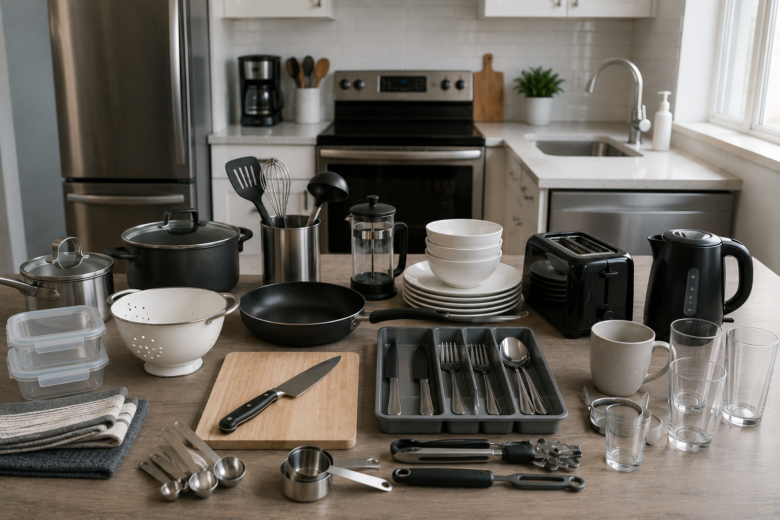
For many routines, a functional starting point might include:
- a good knife;
- a cutting board;
- a spoon or spatula;
- tongs;
- an opener;
- a strainer or colander;
- a few mixing bowls.
Then pay attention to what’s actually missing.
If you constantly find yourself improvising to complete a certain task, that’s a good sign you’ve found something worth buying.
Buying after you’ve identified a need is much more efficient than trying to predict every possible one.
Don’t Start With a Huge Cookware Set
Large cookware sets seem like an easy way to get everything at once.
But some pieces may sit untouched for months.
Instead, think about the meals you make most often.
A basic setup might include:
- one skillet;
- one medium saucepan;
- one larger pot, if it fits your routine;
- one baking sheet or baking dish if you use the oven.
Choose sizes based on the amount of food you normally prepare.
If you’re cooking for one or two people, you probably don’t need oversized pots taking up half your cabinet space.
Buy Dishes for Your Real Life
Another common mistake is buying plates, glasses, and flatware as if you’re preparing for a house full of guests.
Start with the number of people who actually live in the apartment and add a few extras.
That may be more than enough for everyday life without taking up unnecessary space.
The same applies to mugs.
If two people live in the apartment, there’s probably no urgent reason to start with fifteen different coffee mugs.
You can always add more later if your routine changes.
Choose Food Containers You’ll Actually Use
Food storage containers are useful, but they can easily take over an entire cabinet.
Start with a few versatile sizes.
When possible, choose containers that stack or nest together when empty.
Also consider your habits.
If you regularly meal prep, you’ll probably need more containers.
If you rarely store prepared meals, a smaller collection may be enough.
Again, let your routine determine the quantity.
Wait Before Buying Small Appliances
It’s easy to picture a countertop filled with a coffee maker, toaster, blender, air fryer, and several other appliances.
But every appliance takes up space and needs to justify being there.
Before buying one, ask:
How many times a week would I actually use this?
If your answer is “maybe,” wait.
Start with the appliances that are already part of your routine.
After a few weeks in the apartment, it will become much clearer which appliances could genuinely save you time.
Choose Items That Can Handle More Than One Task
When space is limited, versatility matters.
A mixing bowl can be used for food preparation and serving.
A good skillet can handle many different meals.
A practical baking dish can serve several purposes.
That doesn’t mean using products in ways they weren’t designed for. It means avoiding five separate items when one versatile product safely handles the tasks you actually need.
The more useful purposes an item serves, the easier it is to justify the space it takes up.
Use the 30-Day Rule
Once you’ve purchased the basics, stop.
Live with your kitchen for about a month before trying to complete every remaining purchase.
During that time, create a list called:
“What I’m Actually Missing”
Whenever you need something you don’t have, write it down.
If the same item keeps appearing, it’s probably worth buying.
If you think about something once and never need it again, it may not have been essential after all.
That pause protects both your budget and your cabinet space.
Functional Kitchen Checklist
Before buying anything else, make sure you already have what you need to:
- cut and prepare food;
- cook your usual meals;
- serve the people who live in your home;
- store leftovers;
- wash and organize your kitchenware;
- prepare the drinks you consume regularly;
- handle the cooking tasks that are actually part of your routine.
If those needs are covered, your kitchen is already functional.
A Complete Kitchen Is One Where Almost Everything Has a Purpose
There’s a big difference between a well-equipped kitchen and an overcrowded one.
You don’t need to buy everything you might possibly use someday to feel like your home is complete.
Start with what you need. Cook. Pay attention to your routine. Notice what’s missing and add things gradually.
That way, every new item enters your kitchen because it solves a real problem, not because it appeared on a generic checklist.
In the end, a well-planned kitchen isn’t the one with the most gadgets and utensils.
It’s the one where you open a drawer, find exactly what you need, and realize that almost everything inside deserves the space it takes up.