You don’t need to know much about home maintenance to discover that small problems will eventually appear after you move in.
A chair screw comes loose. A cabinet door needs a minor adjustment. A package arrives completely sealed. You buy a shelving unit and realize you need to assemble it. Suddenly, finding a screwdriver feels much more urgent than it did at the store.
That’s why a small tool kit deserves a place in your apartment from the beginning.
For renters, however, there’s an important distinction: owning tools doesn’t mean taking responsibility for repairs that belong to property management or your landlord.
The goal is to handle simple everyday tasks, assemble your own furniture, and make minor adjustments allowed by your lease without turning every small situation into an emergency trip to the store.
Before Buying Tools Understand the Difference Between an Adjustment and a Repair
This is the first step.
In a rental property, problems involving plumbing, electrical systems, heating, air conditioning, appliances provided by the property, or the apartment’s structure should generally be reported to property management or your landlord according to your lease.
Trying to fix something you shouldn’t may make the damage worse and could create questions about responsibility for the repair.
Use your tool kit primarily for your own belongings and simple household tasks.
When the problem involves the property itself, check your lease and request maintenance when appropriate.
Start With Two Good Screwdrivers
You don’t need twenty different types.
For a basic kit, one Phillips-head screwdriver and one flathead screwdriver can handle many simple tasks.
They can be useful for:
- assembling furniture;
- tightening handles;
- adjusting screws on your belongings;
- opening certain compartments;
- disassembling furniture before a future move.
Another option is a screwdriver with interchangeable bits, which takes up less space while providing several sizes.
Choose something comfortable and durable. A poor-quality screwdriver that constantly slips can turn even a simple screw into twice the work.
Keep a Versatile Pair of Pliers
Pliers can help with many small situations.
They can hold small parts, tighten certain components, and assist with assembling or disassembling household items.
For a starter kit, a general-purpose pair is usually enough.
Don’t use pliers for electrical work simply because they’re available. Anything involving wiring or your apartment’s electrical system requires much more caution and, when appropriate, should be handled by maintenance or a qualified professional.
A Measuring Tape May Become Your Most-Used Tool
Few tools are as simple and useful in an apartment as a measuring tape.
You’ll use it before:
- buying furniture;
- choosing rugs;
- ordering curtains;
- organizing cabinets;
- positioning a desk;
- checking whether something will fit through a doorway.
A tape measure around 16 feet long is enough for many common household needs.
Make measuring before buying a habit.
Five minutes with a tape measure can save you from discovering that the perfect piece of furniture is just a few inches too large for the available wall.
Add a Small Hammer
You probably won’t need a hammer every day.
But it’s useful enough to deserve a place in your kit.
Choose a small model that’s comfortable and easy to control.
It can help with certain furniture assembly tasks and other projects allowed under your lease.
Before putting nails or anything else into the walls, however, check your rental rules.
Some properties allow small holes, while others have specific requirements regarding modifications and repairs when you move out.
Include a Compact Level
Crooked pictures are easy to notice after you’ve already finished hanging everything.
A small level can help you align objects, freestanding shelving units, and furniture during assembly.
There are also leveling apps available on smartphones, but a simple physical tool can be more practical for certain tasks.
It doesn’t need to be large.
A compact level can do the job while taking up very little storage space.
Keep Scissors and a Utility Knife in the Same Kit
Throughout your first year, furniture, packages, and household products will probably continue arriving at your apartment.
A good pair of scissors and a utility knife make opening boxes and packaging much easier.
When using a utility knife, always cut away from your body and retract the blade immediately after use.
Be especially careful when opening boxes containing furniture, fabrics, or other products that could be damaged if the blade goes too deep.
Tape and Zip Ties Can Solve Small Problems
A few basic supplies deserve a place alongside your tools.
Keep a small roll of durable tape and some zip ties available.
They can help temporarily with cable organization, labeling, securing lightweight items, and other simple tasks.
But there’s an important rule: temporary solutions shouldn’t replace necessary repairs.
If something that belongs to the apartment is broken, don’t turn tape into permanent maintenance. Document the problem and contact property management when appropriate.
A Separate Flashlight Deserves a Spot Too
Your phone has a flashlight, but it isn’t always the best option.
A compact flashlight lets you illuminate an area while keeping your phone available and preserving its battery.
It’s useful for checking:
- under the sink;
- behind furniture;
- inside closets;
- areas near appliances;
- poorly lit spaces.
Keep it in the same location and make sure you have the correct batteries available.
Keep Everything in One Box
Tools scattered throughout the apartment stop being convenient.
Choose a small toolbox or durable bag and keep everything together.
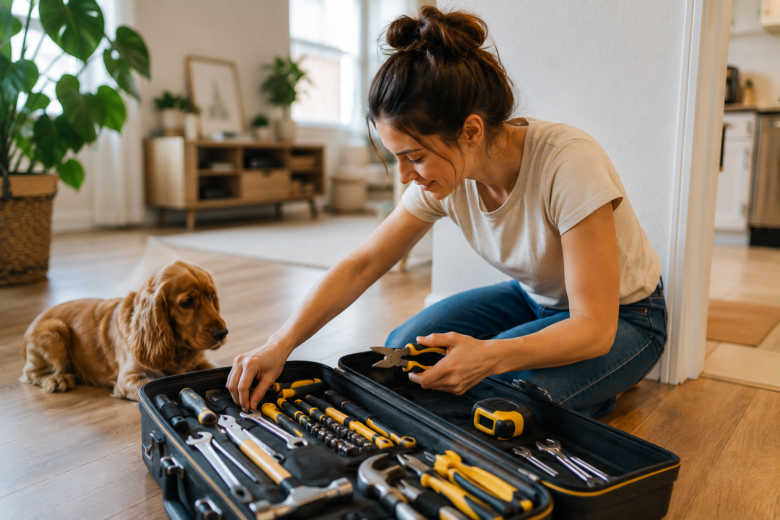
Your starter kit can include:
- Phillips-head screwdriver;
- flathead screwdriver;
- pliers;
- measuring tape;
- small hammer;
- compact level;
- scissors;
- utility knife;
- durable tape;
- zip ties;
- flashlight.
Don’t buy specialized tools before you actually need them.
Start with the basics and expand your kit only when your routine reveals a genuine need.
Sometimes the Best Tool Is the Maintenance Number
Having a basic tool kit gives you the independence to handle everyday tasks without turning every loose screw into a problem.
But renting also means knowing when not to use those tools.
Assemble your furniture, measure your spaces, adjust your belongings, and handle the simple tasks your lease allows.
When something involves the apartment’s structure or major systems, stop before improvising.
A responsible renter isn’t someone who tries to repair everything alone.
It’s someone who knows the difference between a minor adjustment and a repair that should be documented and handled by the right person.
That knowledge, combined with a carefully chosen basic tool kit, can be far more useful during your first year than a huge collection of equipment you’ll probably never use.