You found the perfect sofa for your living room. You checked the dimensions, compared them with the available space in the apartment, and even pictured exactly where it would go. But on moving day, you run into a problem no one expected: the sofa won’t fit through the building entrance.
Or it makes it through the entrance but can’t turn the corner in the hallway.
Or it fits through the hallway, reaches the elevator, and that’s as far as it goes.
This is one of those problems that seems obvious after it happens but is surprisingly easy to overlook when planning a move. It’s not enough to know whether a sofa, mattress, table, or dresser will fit inside your apartment. The furniture also needs to make it through the entire path between the moving truck and the room where it will eventually go.
The good news is that a measuring tape, a few minutes, and the right measurements can help you avoid delays, extra costs, damaged furniture, and a lot of frustration on moving day.
Your Furniture Needs to Fit Through the Entire Route
Before buying a large piece of furniture or bringing something you already own, think about the entire moving path.
Picture the furniture leaving the truck and traveling all the way to its final location.
It may need to pass through:
- the building entrance;
- fire doors;
- hallways;
- an elevator;
- stairways;
- your apartment door;
- interior hallways;
- the room entrance.
A single opening that’s just a few inches too small can stop the entire process.
That’s why you shouldn’t measure only the room. Measure the entire route to it.
Start by Measuring the Furniture Itself
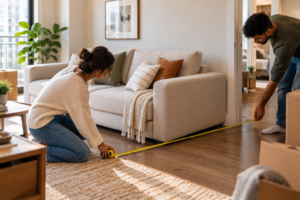
Before checking doors and hallways, you need to know the exact size of the item you’re moving.
Measure its:
- width;
- height;
- depth.
For irregularly shaped furniture, always measure the widest points.
Sofas require special attention because arms, backs, and legs can completely change the amount of clearance needed to get through a doorway.
Also check whether any parts can be removed.
Screw-off legs, removable cushions, detachable headboards, and tables that come apart can turn a seemingly impossible move into a much easier one.
Measure the Main Building Entrance
Now start recreating the entire moving route.
Measure the width and height of the entrance the movers will use.
But there’s an important detail: don’t rely only on the dimensions of the door frame.
Open the door and measure the actual usable clearance.
Door handles, hinges, security bars, and closing mechanisms can reduce the available opening by several inches.
If the property has a separate entrance for moves or large deliveries, find out which one you’ll be required to use.
Don’t Ignore Hallway Turns
A hallway can be wider than your sofa and still prevent it from getting through.
The problem is often the corners.
Imagine carrying a long piece of furniture down a hallway and needing to make a 90-degree turn. You’ll need enough room not only for the width of the furniture but also to rotate it.
Pay attention to:
- hallway width;
- wall-to-wall clearance at corners;
- doors located near turns;
- light fixtures;
- handrails;
- fire extinguishers or equipment mounted on the walls.
If a turn looks tight, write down the measurements.
It could be the most difficult part of the entire route.
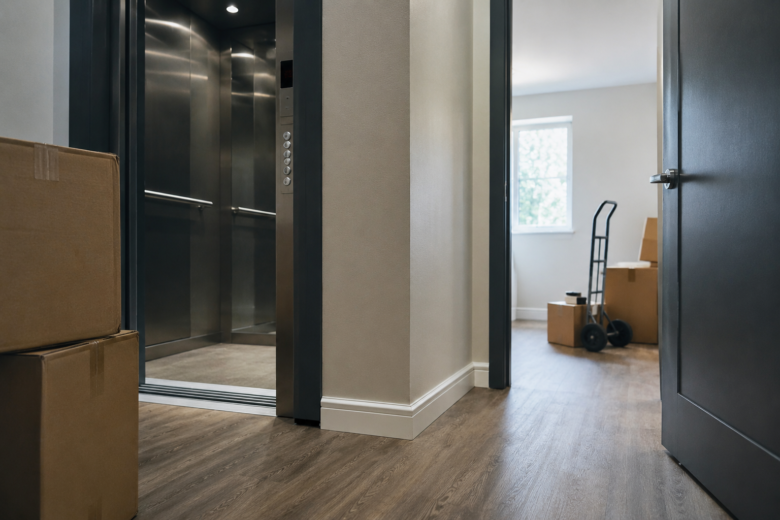
Measure the Elevator Inside and Out
If your move depends on an elevator, don’t assume it will fit every piece of furniture.
Start by measuring the elevator door opening.
Then check the:
- interior width;
- interior depth;
- interior height.
A long sofa may fit diagonally even if it’s longer than the elevator’s depth. However, you’ll still need enough room to tilt and rotate it into position.
Also ask whether the property has a service elevator.
In many buildings, moves must use a designated entrance and elevator, which may have completely different dimensions from the elevators residents use every day.
Check the Rules for Reserving the Elevator
Measurements aren’t the only thing you need to think about.
Some properties require residents to reserve an elevator in advance for moving day.
There may also be:
- designated moving hours;
- time limits;
- required protective padding inside the elevator;
- a specific loading area for the moving truck;
- rules for professional moving companies.
Finding out about these requirements on moving day can delay the entire process.
Check with property management before scheduling your move.
Check the Stairs Even if There’s an Elevator
You may be planning to use the elevator, but it’s still smart to know your backup option.
Some pieces of furniture simply won’t fit inside it.
If there are stairs, check the:
- stair width;
- ceiling height;
- handrails;
- landings;
- turns between floors.
Pay special attention to the landings.
That’s where large furniture will need to change direction, and many stairwells don’t provide much room for that maneuver.
Measure Your Apartment Door
Reaching the correct floor doesn’t mean you’re in the clear yet.
Measure your apartment’s entrance.
Again, focus on the actual usable opening with the door fully open and account for anything that reduces the available space.
Then look at what’s immediately inside the apartment.
Is there a wall directly across from the entrance?
A narrow hallway?
A sharp turn?
Sometimes a piece of furniture fits through the doorway but doesn’t have enough room to rotate once it’s inside.
Follow the Route All the Way to the Final Room
Keep measuring until you reach the exact place where the furniture will go.
If the sofa is going into the living room, trace the entire path to that room.
If a bed is going into a bedroom, check the hallway and bedroom doorway.
For every potential trouble spot, write down the smallest measurement you find.
That number may be far more important than the dimensions of the room itself.
Use This Checklist Before Moving Day
Before buying or moving large furniture, make sure you’ve:
✔ Measured the furniture’s width, height, and depth.
✔ Checked which parts can be removed or disassembled.
✔ Measured the entrance used for moves.
✔ Checked hallways, especially tight corners.
✔ Measured the elevator door and interior.
✔ Found out whether there’s a service elevator.
✔ Checked stairways and landings as an alternative route.
✔ Measured your apartment door.
✔ Checked the entire path to the room where the furniture will go.
✔ Confirmed the property’s moving rules and hours.
A few minutes with a measuring tape can save you hours of improvising later.
The Size of the Room Is Only Half the Measurement That Matters
When we picture new furniture, we naturally think about where it will eventually sit. We measure the wall, check the available floor space, and assume the job is done.
But a piece of furniture only truly fits in your apartment if it can actually get there.
On moving day, narrow hallways and small elevators stop being architectural details and become very real obstacles. Discovering that while your sofa is stuck at the entrance, the moving truck is waiting, and the clock is still running is a situation that can easily be avoided.
Before buying or moving any large piece of furniture, walk the entire route with a measuring tape in your hand.
It’s a simple, quick, and often overlooked step. And it may be exactly what turns moving day into a smooth arrival instead of a long attempt to figure out how to get a sofa through a doorway that was never big enough for it.