
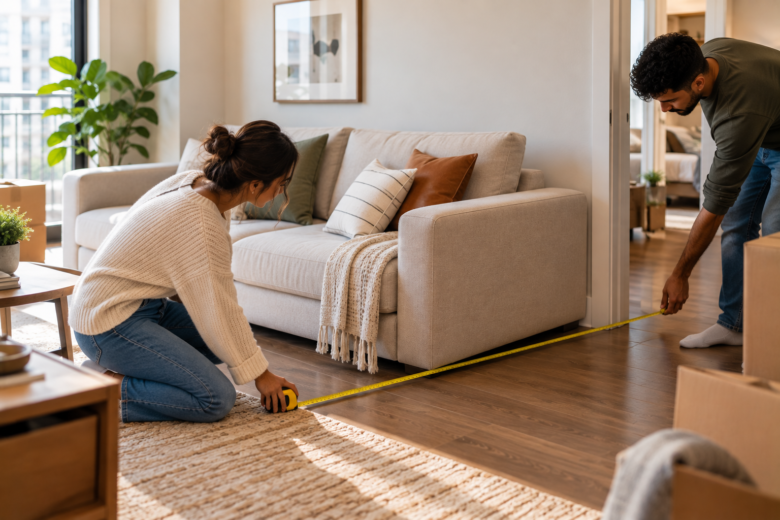
Buying a sofa based only on its appearance can create a very large problem, literally. In a showroom or product photo, the piece may look perfectly proportioned. Inside an apartment, however, it could take up too much space, block a walkway, or fail to reach the living room at all.
Because a sofa is usually one of the most expensive and bulky purchases in a home, relying on estimates is risky. In addition to the furniture’s dimensions, you need to consider the usable area of the room, walking space, door clearance, and the position of other features.
A measuring tape, a few notes, and a simple floor simulation can prevent return fees, delivery damage, and the painful discovery that the perfect sofa does not work in your apartment.
Start by Deciding Where the Sofa Will Go
Before researching models, choose a possible location for the sofa. Study the shape of the room and identify doors, windows, electrical outlets, air vents, heaters, and television connections.
The sofa should not prevent a door from opening, block an air vent, or make a window difficult to access. You should also consider how people move between the entrance, kitchen, bedrooms, and balcony. If the furniture sits in the middle of that route, the room may feel cramped even if the sofa technically fits.
Take pictures of the room and create a simple sketch showing the walls, openings, and furniture that will remain there. The drawing does not need to be perfect. Its purpose is to organize your measurements and help you visualize the layout.
Measure the Available Space in the Room
Measure the wall or area where the sofa will be placed, but do not treat that entire distance as usable space. Baseboards, outlets, curtains, doors, and side tables may reduce the amount available.
Record three main measurements:
- The maximum width the sofa can occupy;
- The available depth without interfering with circulation;
- The allowable height below windows, shelves, or other features.
Measure in more than one location, especially if the wall appears uneven. Apartment walls and corners are not always perfectly straight, and even a small difference can affect how a large piece fits.
If there is a window behind the sofa, consider the height of the back and the space needed to move the curtains. If outlets are located there, make sure they will remain accessible.
Preserve Enough Space for Movement
A sofa can fit between two walls and still make the room uncomfortable to use. The most important measurement is not always the space the furniture occupies, but the space that remains open.
Observe the routes used every day and avoid narrowing important walkways. You should be able to move through the living room without turning sideways, bumping into the sofa arms, or walking around the coffee table.
Consider the distance between the sofa and other furniture as well. A coffee table needs enough clearance for someone to sit down, stand up, and walk past it. Reclining sofas require additional room to open fully. Models with a chaise may extend far into the room and change the main walking path.
Rather than depending on a single measurement described as ideal, test the space according to your household’s routine. Someone with limited mobility, children, or pets may need a wider and clearer pathway.
Understand Every Sofa Measurement
The width listed by the store is not enough to evaluate the sofa’s true size. Review the product specifications and confirm:
- Total width from one arm to the other;
- Total depth from the back to the front edge;
- Overall height;
- Seat height and depth;
- Arm height;
- Chaise dimensions, when applicable;
- Clearance required for reclining;
- Dimensions without feet, cushions, or removable parts;
- Total weight and number of separate sections.
Depth deserves special attention. Some sofas look compact from the front but extend much farther into the room than expected. Height also affects how large the piece feels. A tall back can visually overwhelm a small living room or block part of a window.
If the sofa is modular, confirm the dimensions of every section and how the pieces connect. Also determine whether the chaise can be installed on either side or has a fixed orientation.
Outline the Sofa on the Floor Before Buying
After selecting a model, use removable painter’s tape to mark its exact dimensions on the floor. Outline the full width and depth, including the arms and chaise.
Follow these steps:
- Mark the complete outline of the sofa.
- Place boxes or chairs at the edges to represent its volume.
- Open nearby doors, windows, drawers, and cabinets.
- Walk through your usual routes.
- Simulate using the coffee table and surrounding furniture.
- Sit on a chair inside the outline to visualize the seating position.
- Observe the space at different times of the day.
Tape shows the occupied floor area, but it does not represent height. Boxes or other lightweight objects can help you understand how much the sofa may interfere with sightlines across the room.
Keep the outline in place for a few hours if possible. A layout that seems acceptable during a five-minute test may become inconvenient after you repeat your normal movements around the home.
Check the Entire Delivery Route
It is not enough for the sofa to fit in the living room. It must also pass through the building entrance, elevator, stairway, hallways, and apartment door. Measure the narrowest points and look for tight turns, railings, low ceilings, and light fixtures.
Confirm both the packaged dimensions and the sofa’s dimensions during transport. Ask whether the feet, arms, or back can be removed and what the smallest possible delivery configuration will be.
If the building requires an elevator reservation, a certificate of insurance from the delivery company, or deliveries during specific hours, arrange everything in advance. A delivery refused by property management could result in another fee.
Consider Proportion, Not Just Whether It Fits
A sofa that occupies almost an entire wall may technically fit while making the rest of the room feel unbalanced. Consider the relationship between the furniture, the size of the space, and the number of people who will actually use it.
In a small living room, narrow arms and visible legs can make a sofa feel lighter. A slightly smaller model may also leave room for a side table, proper lighting, and more comfortable circulation.
This does not mean choosing an uncomfortable sofa simply to save space. Compare the usable seating area. Some models are wide on the outside but provide limited seating because of bulky arms.
Review the Return and Delivery Policies
Before paying, read the cancellation, return, and restocking policies. Custom-made or personalized sofas may not be returnable. Other stores charge significant fees or make the buyer responsible for return transportation.
Record your measurements, save the product specifications, and obtain written confirmation of any information provided by the salesperson. If you are still unsure whether the sofa will fit, do not let excitement turn uncertainty into an expensive purchase.
The Right Sofa Must Work Before It Impresses
A sofa does more than occupy space against a wall. It changes the circulation, proportions, and way the living room is used every day. Measuring carefully does not take the joy out of choosing one, it protects the purchase you are about to make.
When the furniture arrives, moves through the entire delivery route, and fits exactly within the planned area, the feeling is more than relief. It confirms that comfort and beauty can coexist with smart decisions.
The ideal sofa is not the one that looks perfect by itself in a photograph. It is the one that enters your apartment, respects your daily routine, and still leaves enough room for life to happen around it.