
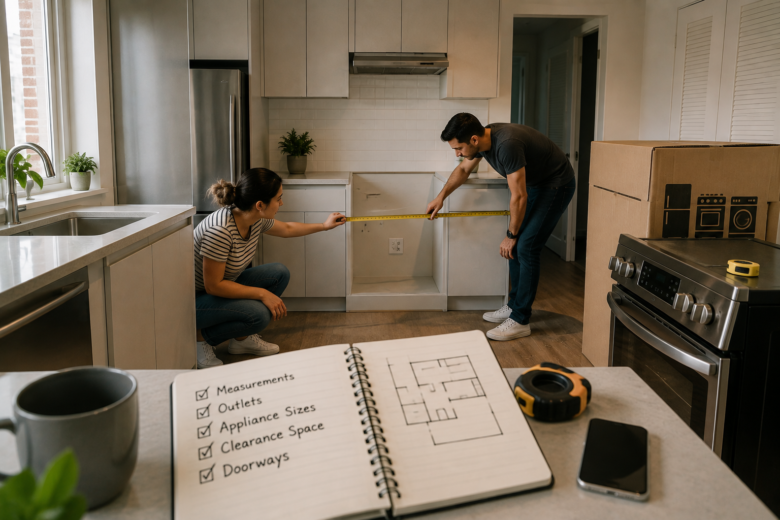
You get the keys to your first apartment and start one of the most exciting parts of moving in: choosing everything that will become part of your new home. A refrigerator, microwave, coffee maker, air fryer, and other appliances quickly make their way onto your shopping list.
Then you run into a problem.
The refrigerator that seemed perfect is a few inches wider than the available space. The microwave doesn’t fit where you planned to put it. The outlet is too far from the countertop. Or worse, you buy an appliance that was already included with the apartment.
When a kitchen is empty, it’s easy to assume that every appliance will find a place. But measurements, outlets, electrical requirements, ventilation, and property rules can turn a simple purchase into an expensive headache.
Before adding any appliance to your cart, take a few minutes to understand the kitchen you actually have not the one you imagined.
First Find Out What’s Already Included With the Apartment
Before measuring anything, confirm which appliances come with the unit.
Depending on the property, you may find appliances such as:
- refrigerator;
- range or cooktop;
- oven;
- microwave;
- dishwasher;
- garbage disposal.
Don’t assume that everything you see during the apartment tour will still be there when you move in.
Ask exactly which appliances are included in the lease and, if possible, confirm that information in writing.
This helps you avoid buying something you don’t need or planning your kitchen around an appliance that will be removed before move-in.
Measure the Space Before Choosing Any Major Appliance
If you need to buy a large appliance, the measuring tape should come out before the credit card.
Measure the:
- width;
- height;
- depth.
But don’t choose an appliance that’s exactly the same size as the available opening.
Some appliances require clearance around the sides or back for ventilation, installation, and proper door operation.
Always check the manufacturer’s specifications before making a purchase.
A few inches can be the difference between an easy installation and an appliance that simply doesn’t work in the space.
Make Sure the Doors Can Open Completely
An appliance can fit perfectly into its designated space and still be completely wrong for the kitchen. Imagine installing a refrigerator next to a wall. It fits inside the opening, but the door can’t open far enough to remove one of the interior drawers.
The same issue can happen with:
- dishwashers;
- ovens;
- microwaves;
- French-door refrigerators.
Look at nearby walls, countertops, islands, and other obstacles.
Don’t just ask, “Will it fit?”
Ask, “Will I be able to use it normally once it’s installed?”
Check Where the Outlets Are Located
Now look at the walls and countertops.
Where are the outlets?
How many are there?
Are they close to where you plan to use your small appliances?
Picture your daily routine with a:
- coffee maker;
- toaster;
- blender;
- air fryer;
- electric kettle;
- hand mixer.
If there are only a few outlets, you may not be able to keep several appliances ready to use at the same time.
Also avoid planning to rely permanently on extension cords or adapters without confirming they’re appropriate for the appliance. Higher-powered appliances should always be used according to the manufacturer’s instructions and the electrical setup available in the kitchen.
Check the Connections Required for Major Appliances
Larger appliances may require specific connections.
If an appliance isn’t included with the apartment, find out exactly what’s available where it will be installed.
Look for:
- the appropriate electrical outlet;
- a gas connection, when applicable;
- a water supply;
- a drain connection;
- necessary ventilation.
Don’t make assumptions based only on what you can see.
Ask property management which specifications are supported and permitted.
Buying the wrong model could mean dealing with returns, delivery fees, and extra days without the appliance you need.
Measure the Countertop Before Buying Small Appliances
Small appliances can create space problems too.
A large air fryer can take over a significant portion of your countertop.
A tall coffee maker may not fit underneath the upper cabinets.
Before buying, measure the:
- countertop depth;
- distance between the countertop and upper cabinets;
- available space near electrical outlets.
Then decide which appliances actually need to stay on the counter.
If they’re all out at the same time, you may have very little room left for preparing food.
Pay Attention to Ventilation
Some appliances release heat or steam while they’re running.
That means the place where an appliance fits isn’t necessarily the place where it should be used.
Before deciding where to put an appliance, read the manufacturer’s recommendations for ventilation and clearance.
Pay special attention to appliances used underneath upper cabinets.
The goal is to avoid directing heat and steam toward surfaces that weren’t designed for constant exposure.
Find Out What You Can and Can’t Change
In a rental apartment, not every possible solution is allowed.
You may consider:
- adding another electrical outlet;
- modifying a cabinet;
- removing a cabinet door;
- drilling holes;
- changing an existing connection.
Before making any changes, check your lease or ask property management.
Even a seemingly minor modification may require approval.
Whenever possible, choose appliances that work with the existing kitchen instead of changing the property to accommodate them.
Don’t Buy Everything Before Living in the Kitchen for a Few Days
This may be one of the easiest ways to save money during your move.
You don’t need to buy every small appliance immediately.
Start with the things you already know you’ll use.
After spending a few days preparing meals, it will become much easier to see what’s actually missing.
Maybe you’ll realize you need an air fryer.
Maybe you’ll discover that you’d rarely use a toaster.
Or you may decide that open countertop space is more valuable than another appliance.
Buying gradually allows you to build a kitchen around your actual routine.
Use This Checklist Before Buying
Before choosing your appliances, make sure you’ve:
✔ Confirmed which appliances are already included with the apartment.
✔ Measured the width, height, and depth of the available spaces.
✔ Checked the manufacturer’s recommended clearances.
✔ Made sure doors and drawers can open completely.
✔ Located the kitchen outlets.
✔ Checked the connections required for major appliances.
✔ Measured the countertop and the space below upper cabinets.
✔ Considered ventilation and heat output.
✔ Checked which property modifications are allowed.
✔ Identified what you truly need to buy right away.
The Right Kitchen Isn’t the One With the Most Appliances
Setting up your first kitchen can make you want to buy everything at once. Every new appliance seems like another step toward making the apartment feel complete.
But a functional kitchen isn’t defined by how many appliances you own.
It works when every appliance fits, can be used safely, has the proper connection, and actually makes your daily routine easier.
Before you buy, grab the measuring tape. Look at the outlets. Check your lease. Think about how appliance doors will open and how much countertop space you’ll still have left.
Those few minutes can prevent unnecessary returns, wasted money, and appliances sitting unused because they never really worked in the space.
Your first apartment doesn’t need to be completely equipped on day one.
Let your routine show you what truly deserves a place in your kitchen. When every purchase has a purpose and a designated spot, you’re not simply filling a new home with things, you’re creating a space that actually works for you.