
When furnishing an apartment, it’s natural to choose furniture based on the space you live in today. You measure the wall, find a table that fits perfectly, choose your bed, and finally buy the sofa that completes the living room.
But apartments change.
A few years from now, your next living room may be smaller, the entrance narrower, or the building may have stairs. That perfect piece of furniture could suddenly become the hardest thing to move.
That’s why there’s one smart question to ask before buying any large piece of furniture: Can it adapt to my next home?
For renters, choosing furniture that can be disassembled and reused can reduce costs, simplify future moves, and prevent you from replacing perfectly good pieces simply because they don’t work in a new space.
The goal isn’t to create a temporary home. It’s to buy more strategically so your furniture can follow you through different stages of life.
Don’t Confuse Disassemblable Furniture With Disposable Furniture
Furniture that can be taken apart isn’t necessarily fragile.
What matters is understanding how it was designed to be assembled and disassembled.
Some furniture uses connectors, screws, and replaceable hardware that allow for careful disassembly.
Other pieces depend on materials or connections that may lose strength after repeated assembly.
Before buying, look for information about the assembly system and read reviews from customers who have already moved or reassembled the product.
Look at How the Main Pieces Are Connected
Before choosing a bed, table, shelving unit, or sofa, try to understand how its main components are connected.
Look for furniture that can be divided into smaller sections without breaking, cutting, or removing permanent parts.
Pay particular attention to:
- accessible screws;
- identifiable connection points;
- removable legs;
- tabletops that separate from the base;
- detachable headboards;
- independent modules.
The easier it is to divide a piece of furniture into smaller components, the easier it will generally be to move through doors, hallways, stairways, and elevators.
Think About the Size of the Pieces After Disassembly
It’s not enough to know that a piece of furniture comes apart.
Find out what you’re left with once it’s disassembled.
A table may have removable legs but still have a huge tabletop that’s difficult to transport.
A bed frame, on the other hand, may break down into several smaller, much easier-to-handle pieces.
Before buying, consider the dimensions of the largest components and imagine how they would fit through a standard doorway or into a moving vehicle.
This is especially important for long or bulky furniture.
Pay Special Attention to Sofas
Sofas are among the most challenging pieces of furniture to handle during a move.
Before buying one, find out whether:
- the legs can be removed;
- the arms are detachable;
- the back can be separated;
- the sofa has modular sections;
- the sections can be transported individually.
Modular sofas can be especially useful for renters who expect to move again because they can often be rearranged to fit a different living room.
Individual modules may also be much easier to transport than one large, solid sofa.
Choose Furniture That Can Serve More Than One Purpose
Reusability isn’t just about being able to put a piece back together.
The furniture also needs to remain useful in another space.
A small dresser might work in your bedroom today and later provide storage in a hallway.
A simple table could start as a desk and eventually become an accent table.
A modular shelving system may be expanded, reduced, or divided into separate units.
Before buying, ask yourself:
“Does this piece only work in this exact spot?”
The more specific the furniture is to one room or layout, the greater the chance that it won’t have a place in your next apartment.
Check Whether Hardware and Parts Can Be Replaced
One missing screw shouldn’t make an entire piece of furniture unusable.
Before investing in larger pieces, check whether the manufacturer offers:
- replacement hardware;
- additional components;
- individual replacement parts;
- assembly instructions online.
This can make a significant difference after a few years.
Disassemblable furniture often includes small hardware that can easily disappear during a move. Being able to replace those parts can extend the life of the furniture.
Keep the Instructions After Assembly
Finished assembling the furniture?
Don’t throw away the instructions.
If there’s a digital version, save the file. If you only have printed instructions, take pictures of the most important pages.
Months or years later, you probably won’t remember exactly how every piece fits together.
Create a digital folder for:
- instruction manuals;
- product model information;
- receipts;
- measurements;
- assembly photos.
When your next move arrives, you’ll already have everything you need.
Create a System for Screws and Small Parts
During disassembly, every piece of furniture should have its own set of hardware.
Place screws, nuts, bolts, and other small components inside a durable plastic bag and label it.
For example:
Hardware – Bedroom Bed Frame
If possible, attach the bag to one of the furniture pieces or keep all labeled hardware bags together in a designated box.
Mixing hardware from different pieces of furniture is an easy way to turn reassembly into a puzzle.
Check Durability Before Buying
If you plan to disassemble and reassemble furniture in the future, evaluate how well it’s built.
Read reviews and look specifically for comments about:
- stability;
- connection quality;
- durability after assembly;
- ease of disassembly;
- problems with screws or connectors.
Don’t choose furniture based only on price or appearance.
An inexpensive piece that needs to be replaced after every move may eventually cost more than a better-designed piece purchased from the beginning.
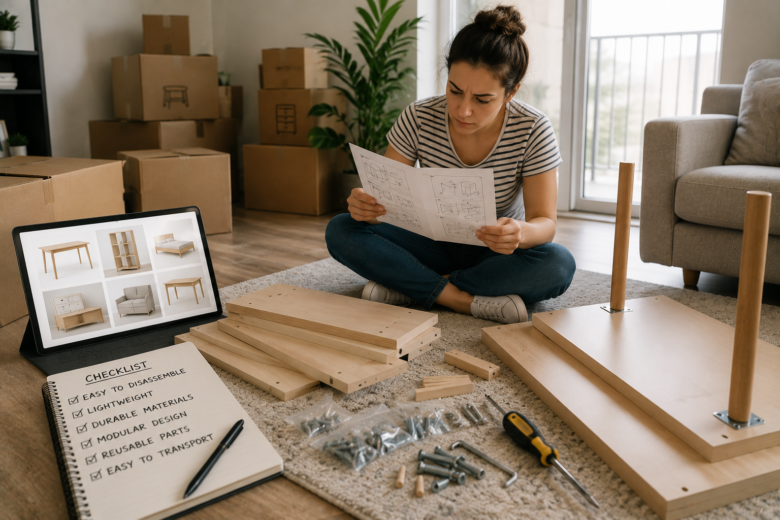
Use This Checklist Before Buying
Before choosing a large piece of furniture, make sure:
- it can be disassembled without damaging the structure;
- the largest pieces will still be easy to transport;
- legs, arms, or bases can be removed;
- the hardware is accessible;
- replacement parts are available;
- the instructions can be saved;
- the furniture can work in different rooms;
- reviews indicate good durability;
- you could realistically reassemble it in the future.
Furnish Your Current Apartment Without Forgetting the Next One
Your apartment today deserves furniture that’s beautiful and functional. But that doesn’t mean every piece needs to work only within its current space.
For renters, flexibility has real value.
A well-chosen piece of furniture can fit through different doorways, survive multiple moves, and take on a new purpose when your home’s layout changes.
Before buying, look beyond the perfect product photo.
Pay attention to screws, modules, measurements, and possibilities.
Because a good piece of furniture isn’t just one that looks perfect in your living room today. It’s one that can make it out of that room when your next move comes and still have a place in the home that comes after it.