
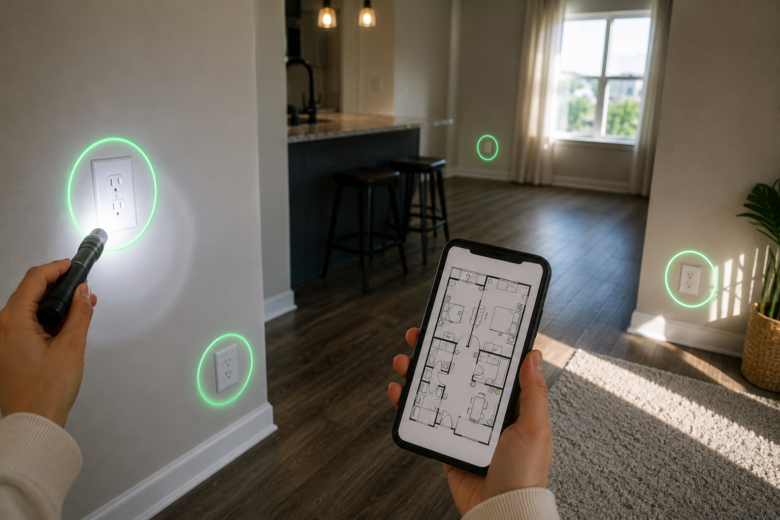
During an apartment tour, it’s natural to focus on room sizes, the kitchen, closets, and lighting. Electrical outlets usually go unnoticed.
The problem often appears after move-in.
You position your bed and realize there isn’t an outlet nearby for your charger. You choose the perfect wall for the TV, but the closest power source is across the room. You set up your home office only to discover that your computer, monitor, and desk lamp would require cords running across the space.
That’s why, before deciding where every piece of furniture will go, it’s worth creating a simple power map of the apartment.
You don’t need electrical knowledge or technical testing. The goal is simply to notice where the outlets are, which devices will need them, and how their location may affect the layout you want to create.
Start With the Furniture and Devices That Actually Need Power
Before the tour, make a quick list of the devices you’ll probably use in each room.
In the bedroom, for example:
- chargers;
- lamps;
- alarm clock;
- television, if applicable;
- electronic devices.
In the living room:
- TV;
- streaming devices;
- gaming console;
- lamps;
- chargers;
- other electronics.
For a home office, consider your computer, monitor, printer, and any other equipment you regularly use.
This list changes the way you look at the apartment. Instead of simply counting outlets, you’ll start evaluating whether they’re located where they’ll actually be useful for your daily routine.
Create a Simple Map During the Tour
You don’t need to draw a professional floor plan.
Open the notes app on your phone and record each room separately:
Bedroom – 3 outlets – two on the bed wall, one near the door.
Living room – 4 outlets – two near the wall where the TV could go.
Photos can also help, as long as you’re allowed to take them during the tour.
Take a wide photo of the room first, followed by pictures of relevant power locations. When you’re planning your furniture layout later, it’ll be much easier to remember where each outlet was.
Don’t Just Count the Number of Outlets
A bedroom can have several outlets and still have an inconvenient layout for the furniture arrangement you imagined.
Pay attention to their position in relation to:
- doors;
- windows;
- closets;
- larger walls;
- possible bed locations;
- TV placement;
- desk areas.
Visualize your furniture in the room.
If the bed goes against that wall, will the outlets still be accessible?
If the sofa is placed where you want it, will any outlet become completely blocked?
This simple exercise can prevent you from creating a layout that depends on cords running across the room.
Look at Where the TV and Home Office Could Work
These two areas often require several electronic devices.
In the living room, identify outlets near walls that could accommodate your television and other electronics.
Don’t assume that the wall that looks best is automatically the most practical choice.
Use the same approach for your home office.
A desk setup needs to work with the equipment you actually use. If there are only a few nearby outlets, that doesn’t automatically mean the apartment isn’t a good fit, but it’s important information for your planning.
You can decide in advance whether that area is really the best place to work.
Check Kitchen Outlets Without Improvised Testing
In the kitchen, many major appliances may already have designated spaces and electrical connections.
Focus primarily on the areas where you might use small appliances, such as a:
- coffee maker;
- toaster;
- blender;
- air fryer;
- electric kettle.
Look at where the outlets are in relation to the countertops and how much space is available for those appliances.
Avoid plugging in equipment or performing electrical tests yourself during the tour without permission.
If an outlet looks damaged, loose, discolored, or otherwise concerning, don’t investigate it yourself. Ask property management about its condition.
Don’t Forget the Bathroom Hallway and Less Obvious Areas
The outlets you miss the most aren’t always located in the most important rooms.
In the bathroom, check whether there are conveniently located power sources for the devices you normally use.
In hallways or transitional areas, think about vacuum cleaners and other cleaning equipment.
If the apartment includes a balcony, storage area, or another additional space, check whether power is available there if that’s important to you.
The goal isn’t to demand an outlet in every corner.
It’s to understand in advance how you’ll be able to use each space.
Check Whether Furniture Will Block Access
This detail is easy to overlook.
An outlet located directly behind a heavy bookcase may become practically unusable.
During the tour, visualize the placement of your largest furniture pieces:
- bed;
- sofa;
- TV stand;
- desk;
- dressers;
- bookcases.
Then compare those positions with the outlets you’ve identified.
Moving the bed a few inches or choosing another wall for a dresser may be enough to keep an outlet accessible.
It’s much easier to figure this out before assembling furniture than to rearrange an entire room afterward.
Don’t Plan to Rely on Extension Cords as a Permanent Solution
Extension cords and power strips can be useful when used properly, but they shouldn’t become an excuse to completely ignore the apartment’s electrical layout.
Never overload outlets or connect multiple high-power devices without considering the equipment’s instructions and limitations.
Also avoid running cords through walkways, where they can become a tripping hazard or get damaged.
For questions about electrical safety, outlet problems, or system capacity, contact property management or a qualified professional instead of improvising.
Use This Checklist Before You Finish the Tour
Before leaving the apartment, make sure you’ve:
- photographed or noted outlet locations;
- checked outlets near the possible bed location;
- reviewed the potential TV area;
- considered where your home office could go;
- checked outlets along the kitchen countertops;
- reviewed the bathroom and secondary areas;
- identified outlets that furniture might block;
- asked about any outlet that appeared damaged.
The Best Layout Starts Before the Furniture Arrives
An electrical outlet may seem like a tiny detail during an apartment tour.
After move-in, it can determine where you work, charge your phone, position your television, or place the lamp beside your bed.
So don’t tour an apartment thinking only: “Will my sofa fit here?”
Also ask: “Will this space work the way I’ll actually use it?”
A few minutes spent checking outlets and power access can help prevent unnecessary extension cords, messy cables, and inconvenient furniture placement.
When it’s finally time to set up your apartment, you won’t be trying to make your electronics adapt to the layout.
You’ll already have a layout designed to work with the life you’ll actually live inside it.