
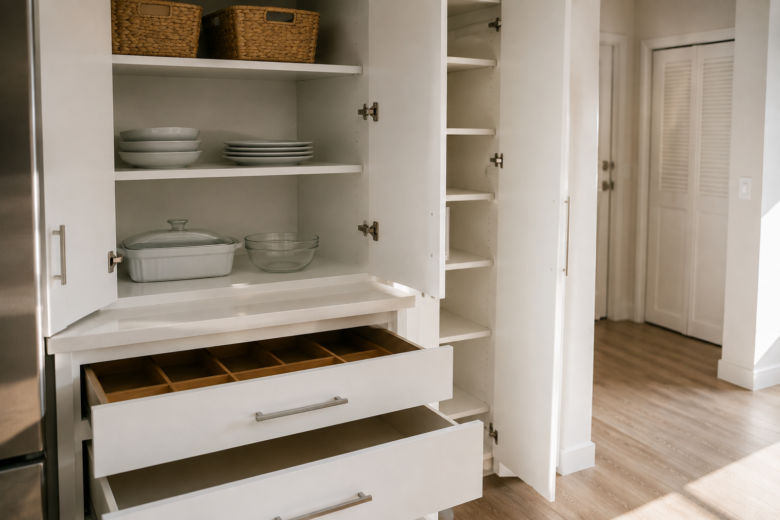
You walk into an apartment, open a few doors, and think, “Great, there’s plenty of storage.”
A few weeks later, moving day arrives, and reality shows up in the form of boxes. Your pots and pans don’t fit in the kitchen cabinets, your cleaning supplies have nowhere to go, the closet is full before you’ve even unpacked all your clothes, and suddenly you’re shopping for organizers to solve a problem you could have spotted before signing the lease.
The number of cabinets and closets in an apartment can be misleading.
A large walk-in closet may have very few shelves. A kitchen cabinet may look spacious from the outside but lose much of its usable space to plumbing. High shelves technically provide storage, but they may not be practical for things you use every day.
That’s why simply counting doors and drawers isn’t enough. Before moving in, you need to figure out how much usable storage space the apartment actually has and compare it with what you plan to bring.
Storage Space Should Be Evaluated From the Inside
During an apartment tour, it’s natural to focus on room size and treat storage as a secondary detail.
Don’t.
Open every cabinet, closet, and drawer you’re allowed to inspect.
You’re not just checking whether they’re in good condition. You need to understand how the space actually works.
Pay attention to:
- depth;
- width;
- height;
- number of shelves;
- spacing between shelves;
- available drawers;
- areas blocked by plumbing.
Two cabinets with nearly identical exterior dimensions can provide completely different amounts of usable storage.
Start by Taking Inventory of What You Already Own
Before measuring the apartment, take a look around your current home.
You don’t need to count every individual item. Instead, group your belongings into categories.
For example:
- hanging clothes;
- folded clothes;
- shoes;
- bedding;
- towels;
- pots and pans;
- small appliances;
- cleaning supplies;
- bathroom essentials;
- luggage;
- seasonal items.
Now identify which categories take up the most space.
Maybe you don’t own many clothes but have a lot of kitchenware.
Or perhaps you have a closet full of coats that need hanging space.
Understanding what you own is essential when deciding whether the new apartment’s storage will actually work for you.
Measure the Usable Space in the Closets
Don’t judge a closet simply by stepping inside and looking around.
Bring a measuring tape.
Measure approximately:
- the width of usable walls;
- shelf heights;
- hanging rod length;
- available depth.
Then compare those measurements with your current closet.
If your clothes currently take up ten feet of hanging space and the new apartment provides half that amount, you already know you’ll need to reduce what you bring or find another storage solution.
Also look for unused vertical space above shelves. That area can be valuable for luggage, storage bins, and items you don’t use regularly.
Evaluate Kitchen Cabinets Differently
The kitchen deserves its own evaluation because the items stored there come in very different shapes and sizes.
Open the lower cabinets and see how much space is lost to the sink and plumbing.
In the upper cabinets, check whether the shelves are adjustable.
Now imagine where you would store:
- plates;
- glasses;
- pots;
- pans;
- food containers;
- pantry items;
- small appliances.
Don’t forget appliances that take up a lot of room.
An air fryer, blender, coffee maker, and other countertop appliances can quickly take over your kitchen if there’s nowhere to store them.
Check Whether There’s a Pantry
A pantry can completely change how much storage a kitchen offers.
If there is one, open it and look at the depth of the shelves.
Very deep shelves may seem ideal, but smaller items can easily disappear in the back.
Extremely narrow shelves, on the other hand, may not accommodate larger items.
If there’s no pantry, figure out where dry goods, drinks, and extra household supplies could be stored.
Don’t Forget the Bathroom Cabinets
Bathroom storage is another area that’s easy to overestimate.
Open the cabinet underneath the sink.
Plumbing may take up a significant amount of the available space.
Think about where you would store:
- towels;
- toilet paper;
- toiletries;
- a hair dryer;
- cleaning supplies;
- extra essentials.
If the bathroom only has a small vanity cabinet, some of those items may need to be stored elsewhere.
It’s much better to realize that during the tour than after moving in.
Look for Storage Outside the Main Rooms
Now search for the less obvious spaces.
Does the apartment have:
- an entry closet;
- a linen closet;
- laundry-area storage;
- balcony storage;
- an exterior storage unit;
- a garage area where storage is permitted?
These spaces can hold bulky items that don’t need to take up valuable room in the bedroom or kitchen.
But make sure they’re actually included with the apartment and ask whether there are restrictions on what can be stored there.
Take Pictures of the Storage Areas During the Tour
With permission, take photos of the apartment’s storage spaces.
If possible, include your measuring tape in the picture.
After the tour, you probably won’t remember the exact height of a shelf or how many drawers were in the kitchen.
Photos allow you to review everything carefully before making a decision or buying storage organizers.
Don’t Expect Organizers to Fix Everything
Baskets, drawer dividers, additional shelves, and storage bins can help you use space more efficiently.
But they can’t create square footage.
If you realize the apartment provides significantly less storage than you need, be realistic.
You may need to:
- reduce the number of belongings you bring;
- choose furniture with built-in storage;
- use vertical space more efficiently;
- rent additional storage.
Planning for this before moving is much easier than trying to find solutions after every box has already arrived.
Use This Checklist Before Making Your Decision
Before deciding that an apartment has enough storage, make sure you’ve:
✔ Opened all available cabinets, closets, and drawers.
✔ Compared the available space with the amount of belongings you own.
✔ Measured the hanging rods in the closets.
✔ Checked how much cabinet space is lost to plumbing.
✔ Evaluated the kitchen cabinets.
✔ Checked whether there’s a pantry.
✔ Reviewed the bathroom storage.
✔ Looked for additional closets and storage areas.
✔ Taken photos of the main storage spaces.
✔ Identified where your largest items would go.
An Organized Apartment Starts Before the Boxes Arrive
It’s easy to look at an empty apartment and assume everything will fit.
Without clothes hanging in the closets, pots filling the cabinets, and towels stacked on the shelves, almost any space looks bigger.
The real question isn’t whether the apartment has a lot of cabinets and closets. It’s whether it has the right storage for the things you actually need to keep.
Before moving in, open doors, measure shelves, photograph closets, and compare the available space with your belongings.
A little planning now can keep your new apartment from starting with stacks of unpacked boxes, overcrowded countertops, and last-minute purchases meant to create storage where there simply isn’t any.
Because organization doesn’t begin when you unpack the first box.
It begins when you choose an apartment that has enough room for the life you’re bringing with you.